

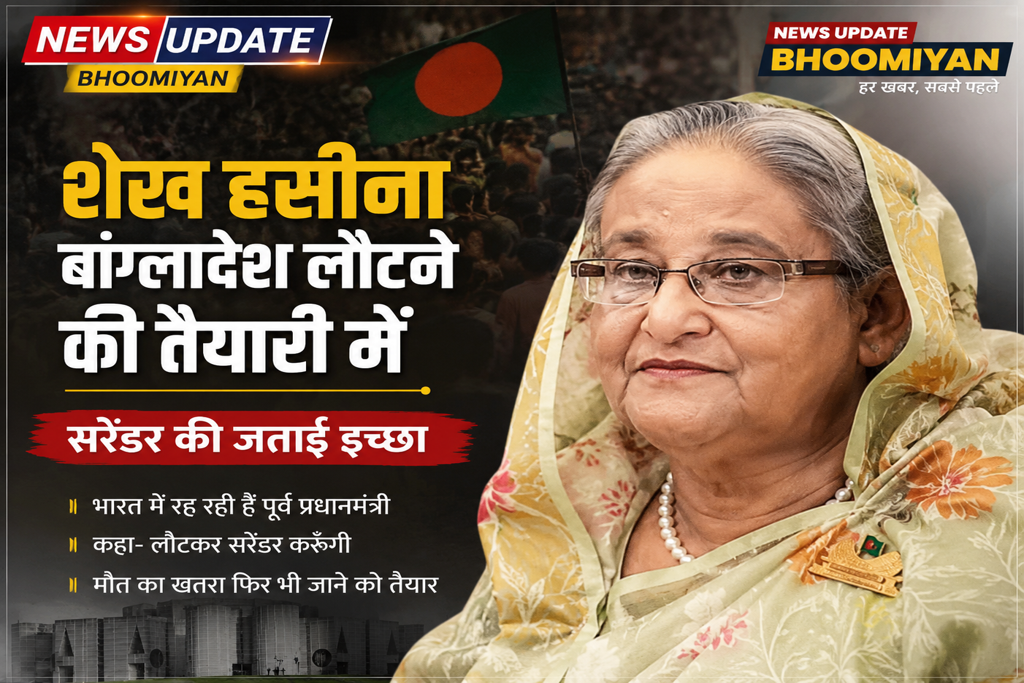
Sheikh Hasina Return to Bangladesh: बांग्लादेश लौटने की तैयारी में शेख हसीना, सरेंडर की जताई इच्छा, जानें पूरा मामला
Sheikh Hasina Return to Bangladesh:
Former
Bangladesh PM Sheikh Hasina Plans to Return Home
Major news
has emerged that former Bangladeshi Prime Minister Sheikh Hasina is preparing
to return to Bangladesh in consultation with senior leaders of her party; it is
worth noting that she has been residing in India since the change of power in
Bangladesh. Speaking to sources, she indicated plans to surrender, though it is
also true that she could face the death penalty in her own country.
Sheikh
Hasina's Legacy and Bangladesh's Political Landscape
Sheikh
Hasina has a long-standing history in Bangladesh, and the progress the country
achieved under her leadership is widely acknowledged. Relations between India
and Bangladesh have shifted significantly following the change in government;
the situation faced by Hindus in Bangladesh over the past few months clearly
indicates that the current administration is hostile towards India. The former
Prime Minister has also expressed a desire to see how the current elected
government treats its principal political opponents. She has stated a
willingness to appear in court, and it is worth noting that members of the
Awami League have been voluntarily seeking refuge in India for the past two
years.
Sheikh
Hasina Says She Is Ready to Face Arrest
In a
telephone interview lasting nearly an hour—spanning late Thursday night into
Friday—78-year-old Hasina said,
"They
might arrest me upon my return; they might even kill me."
She added,
"Yet, I
must go. Leaders and activists from my party are facing severe repression. If
death comes, I want it to happen on my own soil—where my parents are buried and
where their blood was shed."
Strained
India-Bangladesh Relations After Political Change (
Strained
relations between India and Bangladesh:
For your kind information, the opposition party orchestrated a deep-rooted conspiracy to end Hasina's 20-year rule, leveraging the student movement to strengthen its own political standing. She was portrayed as anti-student and depicted as being opposed to youth employment and progress. Sheikh Hasina has categorically denied all these allegations leveled against her.
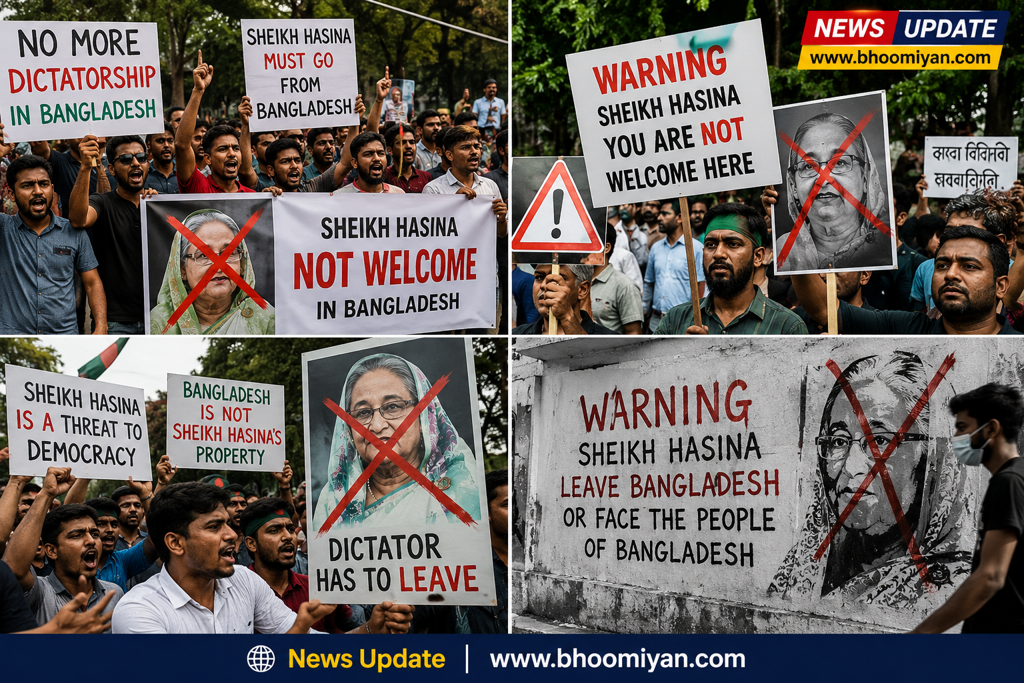
It is
reported that even after two years of turmoil, the current government is
struggling to handle the pressures of power, and the public is dissatisfied
with its governance. A significant development has also emerged suggesting that
a political division could occur in Bangladesh—a major hub for garment
exports—in an effort to bring about stability. We can hope that this might lead
to an improvement in India's currently strained relations with the country.
Bangladesh
Seeks Extradition of Sheikh Hasina
Bangladesh
has repeatedly urged India to extradite Hasina. Hasina has clarified that she
will not accept any political suggestions or talks from any foreign government.
She will decide herself when and under what conditions she will return to
Bangladesh. Till today, she had not shared her plans with any media group. This
is the first time that she has said that she is preparing to return. She said
that she wants to surrender herself and other Awami League leaders who are
currently outside the country will do the same.
A prominent
leader of Bangladesh, including its former home minister, Asaduzzaman Khan
Kamal, has surrendered. No information has come out regarding other members of
his party.
He said that
officials in Dhaka "want to take me back, they are sending repeated
letters to India to send me back."
"I will
go myself."
How
Sheikh Hasina Entered Bangladesh Politics
How Hasina
entered Bangladesh's politics:
Sheikh
Hasina has always been a proponent of democracy; her father—a prominent leader
in the struggle for independence—demonstrated a profound love for the country,
a legacy that is clearly reflected in her own commitment. She entered politics
following the assassination of her father and other family members during a
military coup. Since stepping into the political arena, she has emerged as a highly
influential figure, paving the way for Bangladesh's progress across various
sectors. However, the current government has leveled serious allegations
against her, claiming that she is critical of democracy and seeks to undermine
it.
Economic
Reforms and Political Allegations During Her Rule
Demonstrating
her intellect and political acumen, she improved the economic conditions of the
Muslim-majority nation and strove to lift people out of poverty. Throughout her
20-year tenure, she faced significant opposition. However, she was ultimately
accused of dismantling the system of checks and balances essential to a
democracy. According to a United Nations report, this was the underlying cause
of the regime change in Bangladesh—an upheaval that claimed 1,400 lives.
When Will
Sheikh Hasina Return to Bangladesh?
It remains
unclear exactly when she will surrender.
"I have
faith in justice, and I believe that once the proceedings begin, it will become
clear to people just how much of a sham the trial is—and that is precisely what
I want to prove."
"Let
the People Decide," Says Sheikh Hasina
"Let
the people decide," says Hasina.
Hasina
stated that she was not in contact with Dhaka regarding plans for her return.
"Democracy, the right to vote, the political rights of the Awami League,
and justice are not matters for secret negotiations."
Awami
League Workers Face Challenges After Government Change
Hasina says
she never wanted to leave her country but was compelled to do so this time; she
believes that the people behind the student movement wanted her to stay alive
and for Bangladesh to prosper. She notes that since the fall of her government,
many Awami League workers have faced mistreatment, arrests, legal notices, and
physical assaults.
Sheikh
Hasina's Previous Jail Terms
She also
stated that she has no fear of going to prison; she previously had to go to
jail in 1981—after her father's assassination—due to her campaigns against
military rule. She also faced imprisonment in 2007 on false corruption charges,
eventually being released a year later in 2008.
Sheikh
Hasina's Final Message to the People and Party
She said,
"When a
government functions for a long time, mistakes can happen—no government is
above making mistakes. However, the people have the right to judge the
government's actions—Bangladesh Latest Updates whether good or bad, right or wrong. I leave this decision
to the people."
He urged all
party members to stay united and strong, and even held online meetings covering
125 of Bangladesh's 300 parliamentary constituencies.
"They
may have blamed me, and I may not be able to contest the elections," he
said. "But why should they suspend the Awami League? If we have done
wrong, let the people decide."
For latest updated news visit us