

One wonders why the mood of the weather is shifting and what further possibilities lie ahead regarding these changes.

know more
One wonders why the mood of the weather is shifting and what further possibilities lie ahead regarding these changes.
For the past
few days, you have likely all been enjoying the rain—and perhaps, alongside
that enjoyment, discussing how fortunate it is that the rains have arrived;
otherwise, the heat would have become unbearable.
Weather
patterns do not shift without reason; behind such changes lie indications of
significant anomalies within the broader climatic cycle. The India
Meteorological Department (IMD), in issuing its latest guidelines, has stated
that there are indications that rainfall during the 2026 season (June to
September) may fall below normal levels.
According to
the IMD, this year's seasonal Long Period Average (LPA) rainfall is projected
to range between 90 and 95 percent. Last year, this LPA stood at 87 cm. For
your information, the term "LPA" refers to long-period average rainfall.
Just when we
began to feel that the heat was intensifying—starting in March, right on the
heels of February—strong winds and rainfall intervened to transform the weather landscape completely. In our country, weather conditions vary distinctly
across the North, East, West, and South—and therein lies the true beauty of
this nation. We are providing all these weather updates on our website NewsBhoomiyan .
Weather Changes Influenced by El Niño and La Niña:
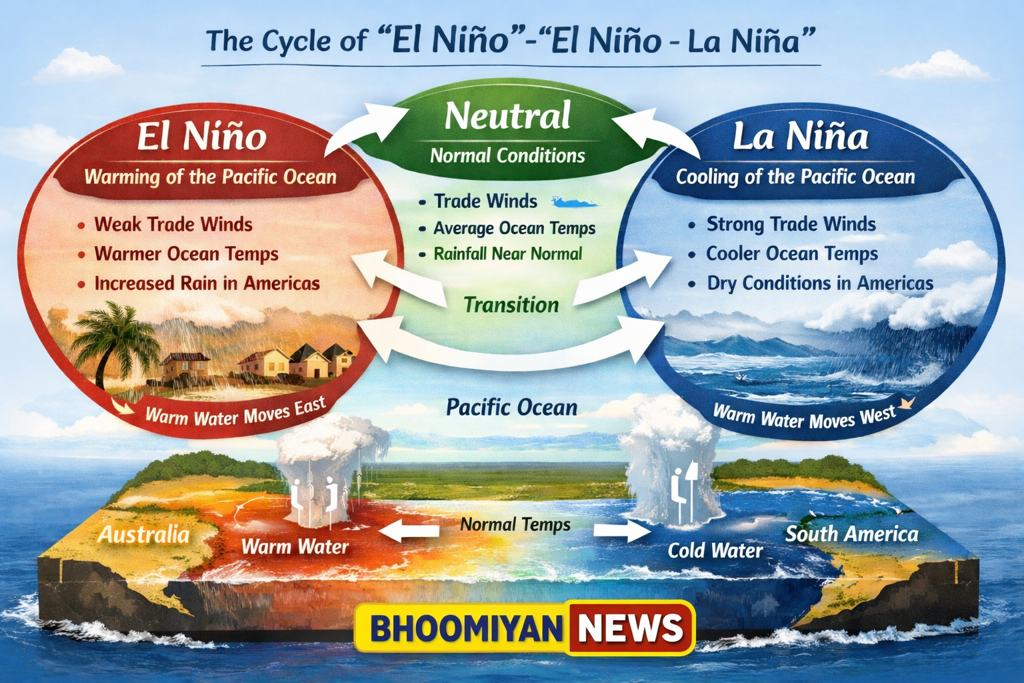
El Niño and
La Niña operate in direct opposition to one another. It is these phenomena that
determine the prevailing weather conditions—and their subsequent impacts—across
regions such as the USA, Australia, India, and South America. The task of
monitoring the climatic patterns originating in the Tropical Pacific Ocean
falls precisely to these systems, as they exert a powerful influence on the
local weather conditions in these regions.